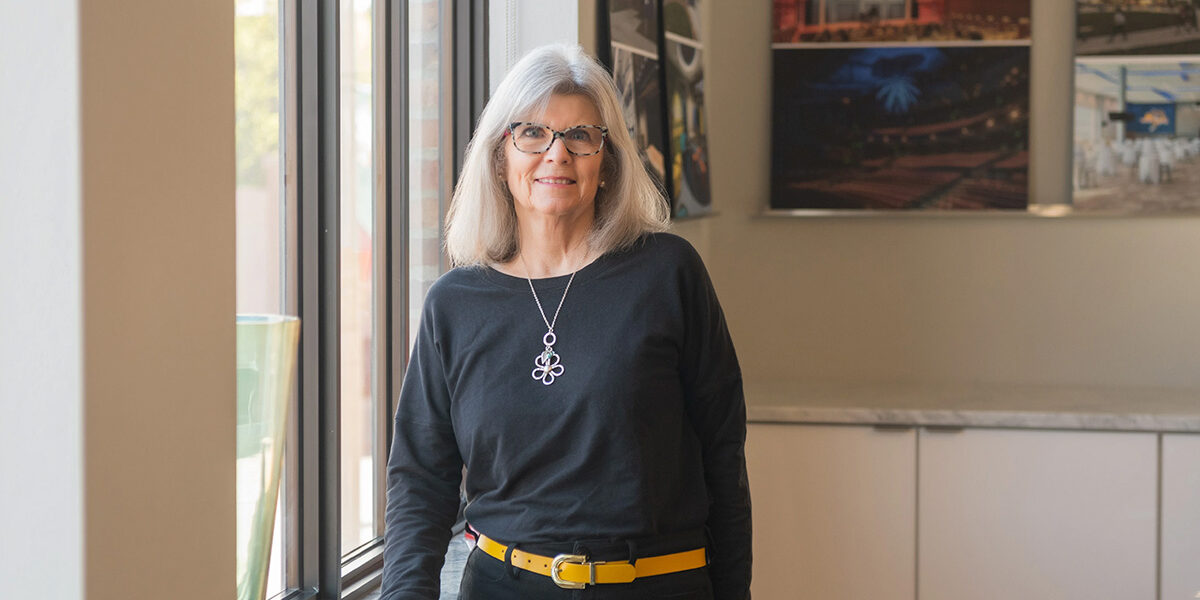

Emeritus is a capstone that enables longtime members to stay connected to their profession after they retire from practice. Eligibility is determined by AIA. If you’re a current member who wants to learn more, contact the AIA South Dakota office.
Kris is a former AIA SD Board of Directors member and was a driving force to plan Design in the Hills each year—for which she was recognized with an AIA South Dakota President’s Award. At the national level, Kris was named a recipient of the Louse Blanchard Bethune Fellowship award for her years representing South Dakota on the AIA Strategic Council.
After more than 45 years in the design field, Kris Bjerke most surprised herself with the not-working part of retirement. “Because I’ve worked my whole adult life, I didn’t know how I would do with a bunch of free time,” says Kris, who officially retired in June 2025. “I find myself with more time, but there’s a whole new environment of things to do.” Kris assumed she’d look for part-time or contract work to fill the gaps, but she says she has yet to even think about it. “I didn’t expect that.”
Instead, Kris embraced less stress. It’s a serious changeup from the spaces she’d fought hard to break into as one of few women in the state pursuing licensure. She started in textiles design at South Dakota State University, drawn not by fashion but by practical application of art. “I was really interested in designing the fabrics themselves,” she says. “I loved working on patterns because they are so technical.”
Fascinated by careers that combined art with design of the built environment, Kris prepared to change her major to landscape architecture. With her marriage came a transfer to Spearfish and Black Hills State University, where she added a minor in architectural drafting to her art major. She knew she’d found her place—but it wasn’t quite ready for all she wanted to accomplish.
Early career directions
Kris got hired right out of college as a drafter at a firm in Spearfish and stayed there several years before moving to Rapid City. At Lund Associates, she obtained her NCIDQ qualification and developed a bit of a specialty in hospitality design: riverboat gaming and casinos primarily on tribal lands. “It was fun, traveling all over the country and even outside the country,” she says. “We had big budgets and a lot of design freedom. I really enjoyed working on the hotels and restaurants that went along with the casinos. It was a niche I had for a while, but I really enjoyed the more ‘meat-and-potatoes’ projects—schools and healthcare buildings.”
Kris knew she could do more. Others took convincing. “When I first wanted to pursue registration, it isn’t only that I wasn’t encouraged,” she says. “I was discouraged by my employers at the time. There weren’t other woman architects around in my community for me to talk to.”
Support for women architects
She found her strongest source of support in a coworker who also started as a drafter and worked her way up. The two women ordered prep materials, studied together, leaned on each other—and on two teammates from Lund Associates’ structural engineering department. “One of the structural engineers saw what we were doing and took time to explain the mathematical part of the load, the building stresses, and all the things you have to calculate,” Kris says. “I passed the two structural parts of the exam because of help from him.”
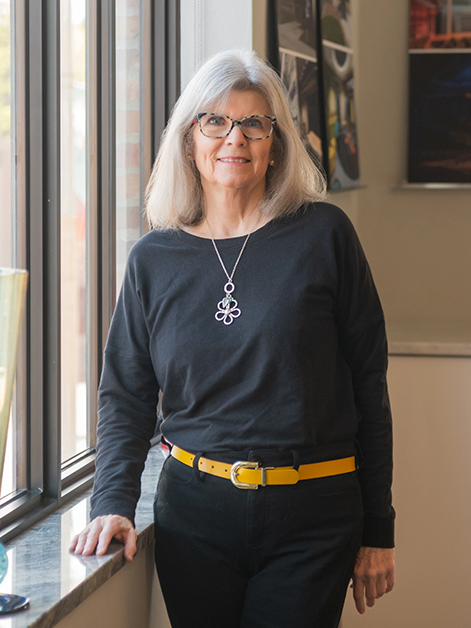
The sudden death of the firm’s sole owner forced hard decisions at the company. Kris thought she might be able to wait on an in-house architect posting at Ellsworth Air Force Base, but a former longtime coworker let her know about a different opportunity. Architecture Incorporated was planning to open an office in Rapid City to handle a large school project. She made the move and finished her career there, spending 15 years as an architect and interior designer.
Kris says although technology is a help for designers across design practices, it’s also contributed to clients’ expectations of drastically constricted timelines. “You used to have more time for a project,” she says. “Now things might be needed before the interest rates go up, or the financing won’t be available. The general public might say, ‘It’s all computerized. You just click a button.’ That’s not true. You still draw; you’re just drawing with a mouse. You still have to do the work and produce the detailed drawings.”
Leadership roles and impact
Kris’ role in AIA South Dakota leadership progressed along with her responsibilities in the office. She was a Board of Directors member and a driving force to plan Design in the Hills each year, for which she was recognized with an AIA South Dakota President’s Award. She also developed another niche talent: writing successful course descriptions so fellow members could earn approved continuing-education credits at AIA SD events. At the national level, she was named a recipient of the Louise Blanchard Bethune Fellowship award for her years representing South Dakota on the AIA Strategic Council.
As a Council member, her study area was inclusivity. The numbers she saw from across AIA’s membership were a wake-up call. “The percentage of minority architects is still so small. I was shocked to see how few Black architects and Native American architects we have nationwide,” she says. “The profession has come a long way, but there’s still so much to do. It’s about 50/50 now in terms of women and men in architectural schools, but the dropout rate for women is still so high. Architecture is really demanding, and it’s still set up for people who have support at home for children, who don’t have to stay home with sick kids or get them to activities.”
Kris sees new architecture programs in previously underserved areas as a signal that change is possible. “I’m so glad South Dakota has its own—that’s huge,” she says of the program at her alma mater, in Brookings. “It’s moving awareness forward. I think it’s a good time for the profession.”
Share your story
Are you a current AIA South Dakota member? Profiles provide a great opportunity for members—and Blueprint SD readers—to get to know one another across the state. Please click to select the form that most closely fits your experience.
AIA SD Architect, Associate, or Emeritus Member Form
AIA SD Newly Licensed Architect Form
AIA SD Allied Member Form